


Children’s riding clothes with UV protection – bring on the sun!
Children who love horse riding prefer to spend their summer holidays at the yard with their beloved four-legged friends. They spend the whole day in the glorious sunshine, looking after ponies, riding, and having a laugh with their friends. However, to ensure that all this summer fun doesn’t result in sunburn, parents should make sure their children have adequate sun protection. With our UV-protective clothing, your child will be fully protected and able to enjoy the summer at the yard to the fullest.
Why is children’s skin so sensitive?
Regardless of skin type, children’s skin is much more sensitive than that of adults due to its structure. For one thing, the individual layers of skin are even thinner, and the cells within these layers are not as densely packed and have less pigmentation than in adults. As the skin has had very little exposure to the sun, the body’s own UV protection is not yet very well developed, meaning that children’s natural protection wears off very quickly.
How can I protect my child from the sun at the riding school?
Generally speaking, adequate sun protection for children can be broken down into three measures: shade, clothing and sun cream. Clothing provides textile sun protection and includes items such as sunglasses and sun hats.
However, it is not always possible to stay in the shade, particularly during riding lessons in the outdoor school. Taking the popular UV-protective swim tops for toddlers as inspiration, Kramer Equestrian has designed children’s riding clothing with a high sun protection factor.
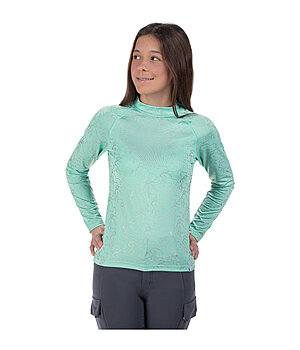
STEEDS offers long-sleeved and short-sleeved UV shirts in bright, candy-coloured shades with a sun protection factor of 30+. Even on milder spring days, textile sun protection can be necessary in our latitudes.

Everything you need for an unforgettable summer
-

Felix Bühler
5.0 1
1
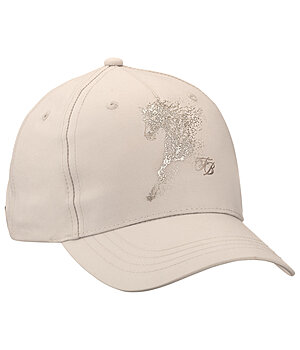
Children's Summer Cap Danna
£12.90from £9.995.0 1
-
STEEDS
5.0 1
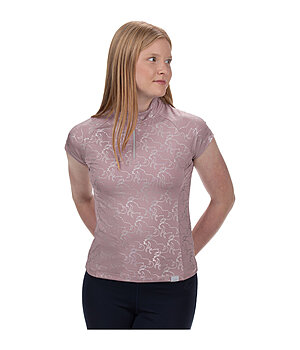
Children's UV Zip Shirt Suna
£19.90from £15.905.0 1
-
STEEDS
5.0 1
Children's UV Shirt Sena II
£17.90from £8.955.0 1
-
 NEWNEW
STEEDS
4.5 67
67
Knee High Socks Argyle
£5.49from £4.394.5 67
-

SHOWMASTER
4.9 24
Horse-Shaped Juicy Candy
(£16.45 / 1 kg)£3.294.9 24
-
SHOWMASTER
5.0 4
Sponge Horse
£1.195.0 4


How does UV-protective riding clothing protect our skin?
Textile sun protection is an important way to protect yourself from harmful UV rays. However, not all clothing provides the same level of protection. For instance, a regular cotton T-shirt only provides a protection factor of 5-15.
As a general rule, consider the following when choosing summer clothing:
- The denser the fabric, the better the sun protection.
- The darker the colour, the better the sun protection.
- Synthetic fibres provide better protection than natural fibres.
- Wet clothing reduces sun protection.

STEEDS and Equilibre’s UV-protective riding clothing is characterised by its tightly woven synthetic fabric, which only allows a minimal amount of UV rays to pass through. The fabric has been treated with a UV-absorbing coating. Furthermore, the garments in our UV children’s collection are highly breathable and quick-drying to prevent loss of functionality due to moisture, as well as to avoid dangerous heat build-up for the child despite the long sleeves.
Gently clean UV clothing
UV clothing is characterised by the density of its fabric and its special coating. If the clothing is washed at too high a temperature or too frequently, the coating may eventually be washed away and the fabric will stretch and lose its density.
Therefore, when washing, please note the following:
- Wash at a maximum of 30°C on a delicate cycle.
- Do not use fabric softener.
- Use a special sports detergent for technical fabrics.
- Do not put in the tumble dryer.
When should we start protecting ourselves from the sun?
In this country, additional sun protection may be necessary as early as March. This depends on a number of factors, which are taken into account in the so-called UV index.
The factors used to calculate the UV index are:
- Cloud cover
- Position of the sun (depending on the time of day and season)
- Thickness of the ozone layer
- Altitude
The UV index ranges from 1 (= low) to 11+ (= extreme). Even on a sunny spring day, the UV index can rise to moderate levels (3-5). From a UV index of 3 onwards, you should provide additional protection for your skin by seeking shade, wearing clothing and using sun cream. You can easily check the current UV index in your area using popular weather apps.
